
Abuja vs Lagos Land: Why a Plot in Abuja's Most Prestigious District Costs 10x Less Than Lekki
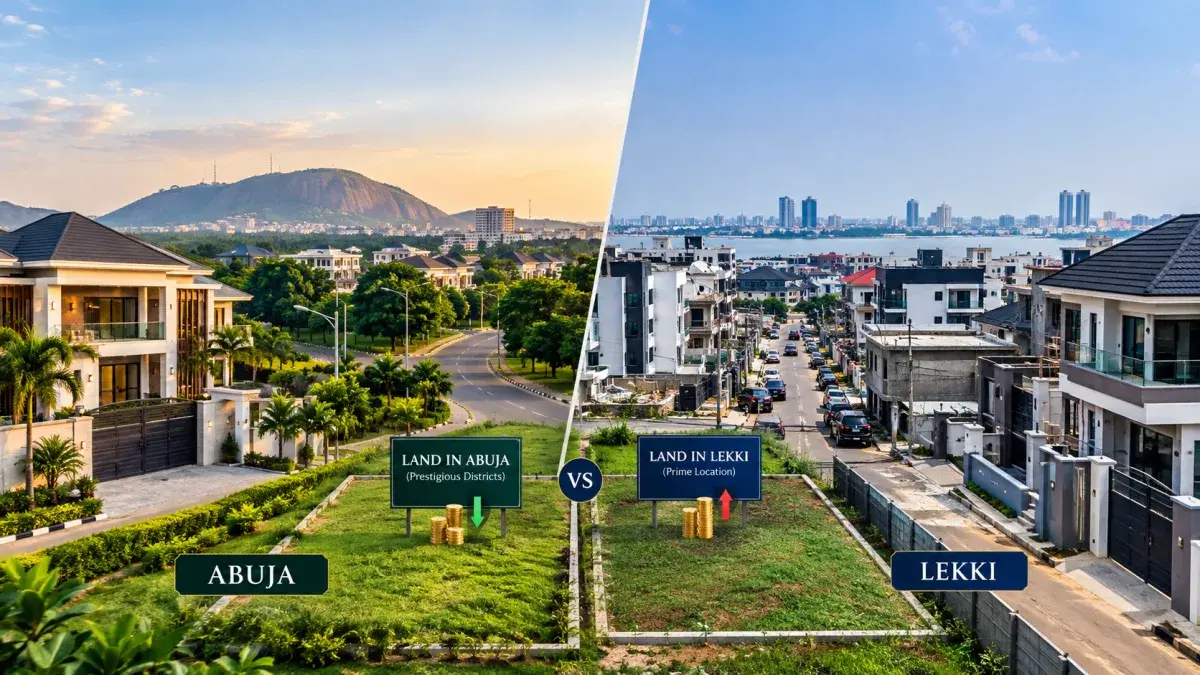
Every Nigerian land buyer eventually faces the same fork in the road. Lagos or Abuja?
Most articles answering this question compare houses and flats. That is the wrong comparison for the buyer who is actually in the market, because most Nigerians building wealth through property are not buying finished buildings. They are buying land.
So let us compare what actually matters: the cost of a plot, what you get with it, and whether you will still own it in ten years. The 2026 numbers are more lopsided than most buyers expect.
The Headline Number: Price Per Square Metre
Land is priced per square metre. That is the only honest way to compare two cities, because a "plot" means different things in different places. Here is where the two markets actually sit in 2026.
In Lagos, land in Lekki Phase 1 and the prime Ikoyi corridor trades between ₦1.2 million and ₦1.7 million per square metre. The developing corridors, Lekki-Epe and Sangotedo, range from ₦450,000 to ₦900,000 per square metre.
In Abuja, THE ZION at Katampe Extension, one of the capital's most prestigious residential addresses, sells at ₦25 million for 200sqm. That is ₦125,000 per square metre.
Read those two figures together. Abuja's premium district costs roughly one-tenth of Lagos Phase 1 land per square metre. Not 20% cheaper. Not half. Approximately 10 times less, for a comparable prestige tier in a capital city.
The gap widens further in the growth corridors. TJ Homes Phase 4 in Pyakasa, on the Kabusa-Ketti Expressway, is priced at ₦3 million for 180sqm, approximately ₦16,700 per square metre. Lagos's equivalent developing corridor starts at ₦450,000 per square metre. That is a difference of roughly 27 times.
Like-for-Like: What ₦6.5 Million Buys in Each City
Abstract per-square-metre figures are useful, but plot comparisons are clearer. Consider a 500sqm plot, the standard full plot size in the Lagos market.
In Sangotedo, a 500sqm plot runs ₦20 million to ₦50 million. In Bogije, Ibeju-Lekki, ₦8 million to ₦25 million. Only in Epe's interior and secondary-road areas do prices fall to ₦1.5 million to ₦4 million, and those plots typically come with unpaved access, no electricity infrastructure, and a 7-to-10 year investment horizon before meaningful appreciation.
In Abuja, TJ Homes Phase 5 in Kuje offers a 500sqm plot at ₦6.5 million. That is three times cheaper than the bottom of Sangotedo's range, inside a planned estate, in the Federal Capital Territory, with documented title.
And at the true entry level, Ephatha Phase 2 in Kuje starts at ₦990,000 for 150sqm. Under one million naira for a documented plot in Abuja. There is no equivalent in the Lagos market at that price with comparable title security and estate infrastructure.
TehilJem Abuja Land Prices, 2026
Here is TehilJem's current active land portfolio with per-square-metre pricing, so you can compare directly against any Lagos listing you are considering:
| Estate & Location | Plot Size | Price | Per sqm |
|---|---|---|---|
| Ephatha Phase 2, Kuje | 150sqm | ₦990,000 | ₦6,600 |
| Ephatha Phase 2, Kuje | 250sqm | ₦1.8M | ₦7,200 |
| TJ Homes Phase 4, Pyakasa (Presale) | 180sqm | ₦3M | ₦16,700 |
| TJ Homes Phase 5, Kuje | 500sqm | ₦6.5M | ₦13,000 |
| Prestige Villa, Lugbe | 400sqm | ₦11M | ₦27,500 |
| Dominion Estate Phase 3, Lugbe | 300sqm | ₦14.5M | ₦48,300 |
| The Lush Landmark, Idu | 400sqm | ₦20M | ₦50,000 |
| TJ Homes Phase 2, Life Camp | 200sqm | ₦15M | ₦75,000 |
| Jemzy's Court, Guzape | 230sqm | ₦25M | ₦108,700 |
| THE ZION, Katampe Extension | 200sqm | ₦25M | ₦125,000 |
Lagos Land Benchmarks, 2026
And here is where Lagos land sits, drawn from current market data:
| Lagos Area | Tier | Price per sqm | 500sqm plot |
|---|---|---|---|
| Lekki Phase 1 / Old Ikoyi | Prime | ₦1.2M – ₦1.7M | ₦600M+ |
| Lekki-Epe / Sangotedo | Developing | ₦450k – ₦900k | ₦20M – ₦50M |
| Bogije, Ibeju-Lekki | Outer | ₦16k – ₦50k | ₦8M – ₦25M |
| Epe (near expressway) | Outer | ₦8k – ₦15k | ₦4M – ₦7.5M |
| Epe interior / secondary roads | Fringe | ₦3k – ₦8k | ₦1.5M – ₦4M |
The Argument Lagos Makes, and Where It Holds
Lagos land bulls make a fair case, and it deserves an honest hearing. Lagos is Nigeria's commercial capital. It has the deeper economy, the larger population, and genuinely transformative infrastructure underway: the Lekki Deep Sea Port, the Dangote Refinery, the Lekki-Epe Expressway dualisation, and the Fourth Mainland Bridge.
Properties within 5km of the coastal road corridor have recorded appreciation spikes of 25 to 40%. Epe recorded an 18% nominal increase in 2026. Early buyers in Ibeju-Lekki have made substantial returns. These are real outcomes.
The honest counter is not that Lagos land does not appreciate. It does. The counter is that you are paying a very high entry price for that appreciation, and carrying a specific risk that Abuja buyers largely do not.
The Risk Lagos Buyers Carry: Title
This is the section most comparison articles avoid, and it is the one that decides the outcome for most buyers.
Abuja operates a centralised land administration system through the Federal Capital Territory Administration, backed by AGIS, the Abuja Geographical Information System, which maintains a digital cadastre of land records. Before you pay for a plot, you can commission an AGIS land search and receive a definitive answer: is this land free, encumbered, or under government acquisition?
Lagos operates a state land registry alongside a persistent parallel structure known as the Omo Onile problem: family and community landowning groups who assert claims on land, demand repeated payments from buyers and developers, and in documented cases have sold the same parcel to multiple buyers.
Market analysts comparing the two cities have noted this directly: Abuja's centralised regime and digital cadastre structurally reduce fraud risk relative to Lagos, where land disputes and title complications are considerably more common.
Understand what this means in practice. In Abuja, the question "is this land clean?" has an official answer you can obtain before payment. In Lagos, that question frequently has several competing answers, and you may not discover which one prevails until you attempt to develop or resell.
For a buyer purchasing land as a store of value, which is what most land buyers are doing, this is not a footnote. It is the whole proposition. Land that you cannot definitively prove you own is not an asset. It is a dispute waiting to surface.
Why This Matters Most If You Cannot Be Physically Present
If you live in Lagos and buy land in Lagos, you can visit the site, respond to a claim, engage community stakeholders, and defend your position in person.
If you live in Abuja, Port Harcourt, Enugu, London, or Houston, you cannot. Your documentation has to defend the land on your behalf.
This is where Abuja's structural advantage becomes decisive rather than merely preferable. A registered survey plan, physical beacons matching that plan, an approved estate layout, a clean AGIS search, and a title document constitute a defensible position that does not require your presence to hold.
It is worth noting how one TehilJem client described this. Ahmed Tiamiyu, who bought at Katampe, put it plainly: after being scammed previously, he was afraid to try again, until a referral led him to a developer that delivered transparently. That is the specific fear this documentation structure is designed to eliminate.
What Drives Abuja Land Appreciation
Abuja land value is driven by infrastructure-led expansion outward from a planned core, and because Abuja develops according to a Master Plan, growth corridors are identifiable before they mature. That predictability is precisely what a land banking strategy requires.
The current corridors:
- Idu: the Abuja-Kaduna Railway Station has transformed this into a premium residential and commercial zone. The Lush Landmark sits here, from ₦15M for 250sqm.
- Pyakasa: the Kabusa-Ketti Expressway corridor is driving southern outer-ring expansion. TJ Homes Phase 4 is positioned directly on it, from ₦3M.
- Lugbe: one of Abuja's most commercially active satellite towns. Rents in Lugbe and Kubwa rose an estimated 20 to 35% during 2025 as tenants priced out of the core moved outward. Rising rents signal tightening demand, which is exactly what drives land value in a corridor. Prestige Villa (400sqm, ₦11M) and Dominion Estate Phase 3 (300sqm, ₦14.5M) are both sited here.
- Kuje: Abuja's most accessible entry corridor, with genuine estate infrastructure at prices that have no Lagos equivalent. TJ Homes Phase 5 from ₦4M and Ephatha Phase 2 from ₦990,000.
- Life Camp, Guzape and Katampe Extension: established premium districts with the strongest long-term appreciation records in the FCT.
The Comparison at a Glance
Across the factors that actually determine a land investment outcome:
| Factor | Abuja | Lagos |
|---|---|---|
| Premium tier, per sqm | ~₦125,000 (Katampe Ext) | ₦1.2M – ₦1.7M (Lekki Ph1) |
| Growth corridor, per sqm | ~₦16,700 (Pyakasa) | ₦450k – ₦900k (Lekki-Epe) |
| 500sqm plot, planned estate | ₦6.5M (TJ Ph5, Kuje) | ₦20M – ₦50M (Sangotedo) |
| True entry point | ₦990,000 (Ephatha Ph2) | ₦1.5M+ (Epe, no infrastructure) |
| Land title system | Centralised, FCTA + AGIS cadastre | State registry + Omo Onile claims |
| Pre-purchase title search | AGIS search, definitive answer | Complex, dispute-prone |
| Fraud risk profile | Structurally lower | Structurally higher |
| Development pattern | Master Plan, corridors predictable | Organic, corridor-led |
| Suits remote buyers | Yes, documents hold the position | Harder without local presence |
The Verdict
If you have substantial capital, deep Lagos market knowledge, a trusted local network, and the ability to physically manage title risk, Lagos land remains a legitimate high-ceiling play.
For everyone else, Abuja presents a materially stronger position on land specifically:
- Roughly 10x lower cost per square metre in the premium tier, and up to 27x lower in growth corridors
- Genuine sub-₦1M entry points inside planned estates with infrastructure, something Lagos does not offer at comparable title security
- A centralised, digitised title system where a definitive pre-purchase land search is available
- Master Plan-driven development, making growth corridors identifiable in advance
- A market where a buyer who cannot be physically present can still hold a defensible position
This is not a claim that Abuja land always appreciates faster than Lagos land. It is a claim that Abuja delivers substantially more land, with substantially better title security, per naira invested, and for most land buyers, that is the calculation that matters.
Buy Land in Abuja With TehilJem
TehilJem Nigeria Limited is a CAC-registered (RC-1862633), REDAN-certified, EFCC SCUML-compliant real estate development company with 25+ completed projects across 13 active locations and 5+ years in the Abuja market.
Our current land portfolio spans every budget (prices as at September 2026):
- Ephatha Phase 2, Kuje: 150sqm ₦990,000 · 180sqm ₦1.3M · 250sqm ₦1.8M
- TJ Homes Phase 4, Pyakasa (Presale): 180sqm ₦3M · 300sqm ₦4.2M
- TJ Homes Phase 5, Kuje: 250sqm ₦4M · 400sqm ₦5.5M · 500sqm ₦6.5M
- Prestige Villa, Lugbe: 400sqm ₦11M
- Dominion Estate Phase 3, Lugbe: 300sqm ₦14.5M
- TJ Homes Phase 2, Life Camp: 200sqm ₦15M · 300sqm ₦20M · 450sqm ₦25M
- The Lush Landmark, Idu: 250sqm ₦15M · 320sqm ₦18M · 400sqm ₦20M
- Jemzy's Court, Guzape: 230sqm ₦25M
- THE ZION, Katampe Extension: 200sqm ₦25M · 400sqm ₦47M · 500sqm ₦58M
Every plot comes with a survey plan, approved estate layout, allocation documentation, and full support through title perfection. Payment plans are available across the portfolio. Site inspections are open at every active location, and we arrange video inspections with GPS confirmation for buyers outside Abuja.
Browse the full portfolio at tehiljem.com/properties, or message our team directly on WhatsApp at +234 806 864 5460. Bring your questions, and ask to see the documents. That is the point.